


Supplement 1.10: Radiation detectors (3/5)
Quantum detectors (2/4)
Vacuum photodiodes continued from the previous page
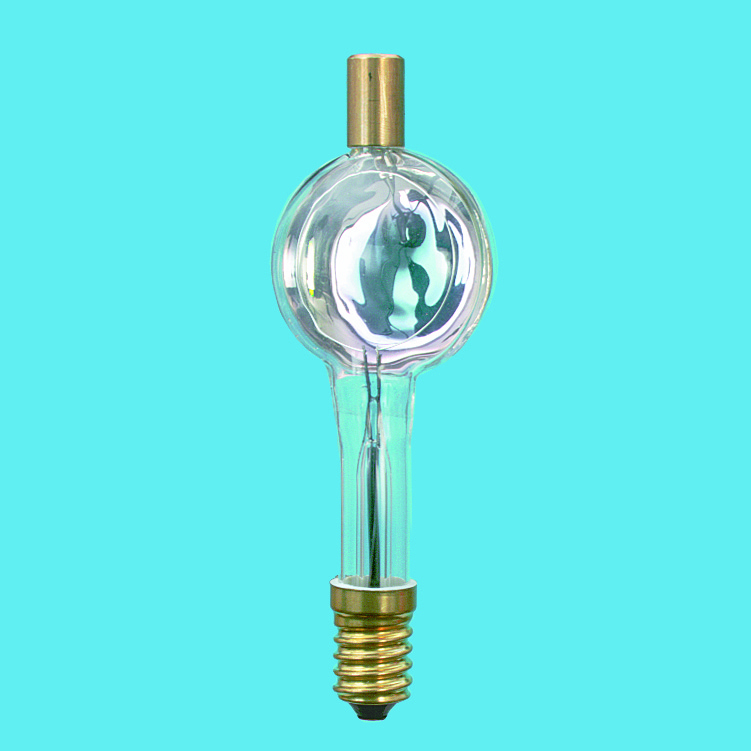
The educational equipment company LD Didactic GmbH (or: Leybold®) offers a very good photodiode for use in physics lessons. It is used to experimentally determine Planck’s constant h.
Here, the upper metal cap serves as a contact for the photocathode, which is made of potassium and has been vapour-deposited on the inside of the spherical part of the tube. The work function of potassium is 2.24 eV; photons with wavelengths shorter than 550 nm (green) produce a photoelectric effect. The anode is designed as a ring-shaped wire and is connected to the E14 screw base.
The manufacturer’s website (last access: 01.04.2026) offers several guides in the ‘Related Documents’ menu on how to determine Planck’s constant in the classroom. On first glance, you may notice that the polarity of the voltage between the cathode and anode appears reversed compared to the diagrams on the previous page: the photodiode is operating in reverse bias. However, for the purpose of the experiment – the detection of photons and the determination of Planck’s constant – reverse-bias operation of the photodiode is necessary.
An important characteristic of vacuum photodiodes is their usable spectral range. This is determined by two factors:
-
The material of the photocathode determines the long-wavelength limit of sensitivity. The
work function of the electrons varies depending on the metal
used for the photocathode. As the
wavelength of light increases, the photon energy decreases. When the photon energy
becomes too low to overcome the work function, the so-called
cut-off wavelength is reached.
This fact, combined with the observation that even higher intensity beyond the cut-off wavelength cannot induce the photoelectric effect, could not be explained by classical physics and led to the photon model of light. - The short-wavelength limit of sensitivity is determined by the absorption behaviour of the glass used for the tube and is usually 300 nm. Quartz glass allows applications deeper into the ultraviolet down to 200 nm.
The cathode of the RCA 935 photodiode is coated with a caesium-antimony alloy and has a cut-off wavelength of 600 nm (orange). Its sensitivity S, i.e. the ratio of the photocurrent (in A) to the absorbed radiant power (in W), is highest in the near-ultraviolet region at around 350 nm, where it is S=0.03 A/W. This spectral characteristic of the cathode is designated by the abbreviation S-5. Further cathode materials and their spectral sensitivities are presented in the following section on photomultipliers.
Not every photon with an energy greater than the work function can release an electron. An absorbed photon increases the kinetic energy of an electron, but its direction of motion is initially indeterminate. Only through collisions with other electrons can it reach the cathode surface and escape into the vacuum. It is partly because of these necessary collisions that only electrons close to the surface are able to escape from the cathode surface. The cathode material deposited onto a substrate therefore needs to be only a few atomic layers thick.
A detailed account of the physics and technology of photodiodes can be found in RCA phototubes and photocells, Technical Manual PT-60, published in 1963.


