Supplement 1.13: Semiconductor photodiodes (3/4)
Types of photodiodes
Compared with vacuum photodiodes and photomultipliers, semiconductor photodiodes are usually small. However, their photosensitive area can be as large as that of vacuum photocathodes.
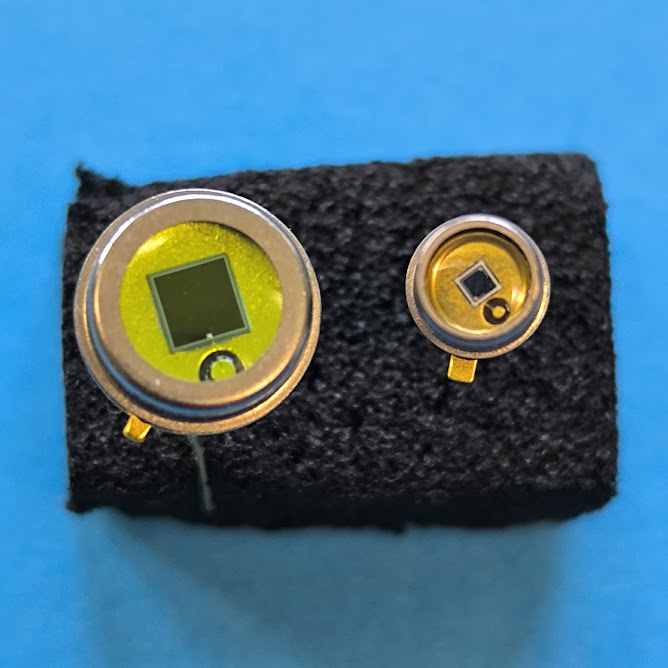
Centre: PT511B pin photodiode from Roithner Lasertechnik (top left) with ball lens, made of InGaAs for measurements in the near-IR, sensor diameter 300 µm. BPW 34 pin photodiode from Vishay (top centre, rear view on the right), made of Si, sensor area 3×3 mm. BP 104FS pin photodiode from ams OSRAM (bottom row), made of Si with a daylight filter for measurements at 950 nm, SMD version, sensor area 2.2×2.2 mm.
Right: SD444-12-12-171 pin photodiode from Advanced Photonics (front view), sensor diameter 17.7 mm. pin-Fotodiode PIN 10DF from UDT (rear view), with a filter for flat spectral sensitivity from 450 to 900 nm, sensor area 1 cm². Both made of Si, with a BNC connector.
Spectral sensitivity
On the previous page, it was already noted that the sensitivity of semiconductor diodes is exceptionally high compared with that of vacuum detectors. This also applies to the quantum yield. The figures for the most important materials – silicon, germanium and indium gallium arsenide – are shown in the following graph.
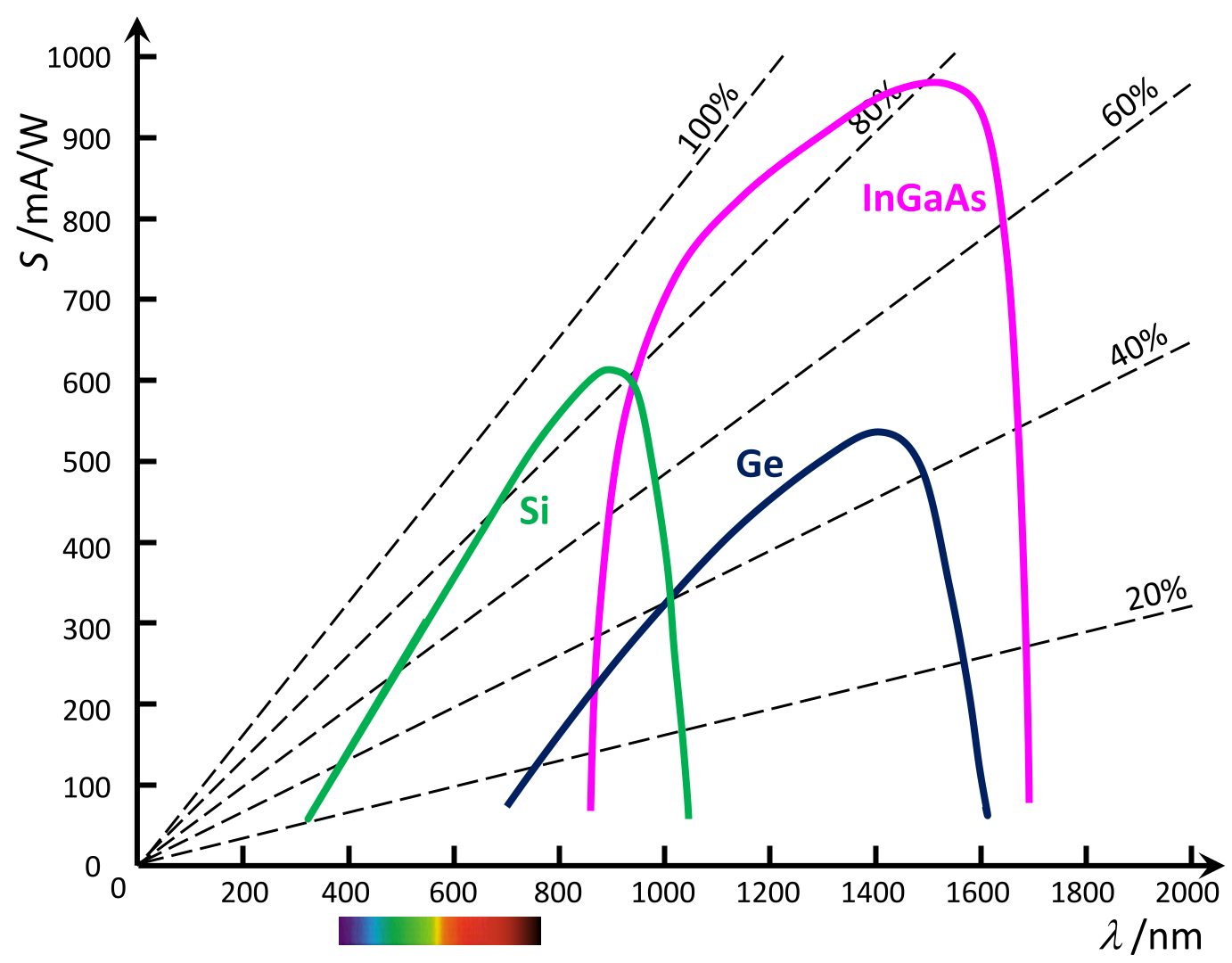
The dotted lines show the relationship between the percentage quantum efficiency QE and the sensitivity S as a function of wavelength; see Question 1 in the supplement on vacuum photodiodes. Clearly, silicon and indium gallium arsenide achieve a quantum efficiency of almost 100 per cent.